beginner6 min read·Updated July 16, 2026
Data Structures Explained: How Containers with Rules Solve Real Problems
Learn data structures through a mental model of containers with rules. Walk through building a stack step by step, then apply it to debug nested function calls.
By Learnisim AI·Published July 16, 2026
LEARNING ARCWhy → Model → Worked example → Edge cases → Apply
PREREQUISITES
- basic programming concepts (variables, functions)
Why
Why Data Structures Matter: The Problem They Solve
Imagine you have a messy pile of 1000 business cards. Finding a specific person's phone number means flipping through the whole stack — slow and frustrating. Now imagine those cards are sorted alphabetically in a tiny address book. You can jump straight to 'S' for Smith in seconds. That's the essence of data structures: they are ways to organize data so that common operations (like search, insert, delete) are fast. Without a good data structure, even a simple task like 'find the largest number' can become a slog through every single item. Different structures trade off speed for different operations — some make adding data fast, others make searching instant, and some balance both. The right choice can turn a 10-minute task into a 10-millisecond one.
Model
The Mental Model: Containers with Rules
Think of a data structure as a container that holds items, but with a twist: each container has a contract — a set of rules about how you can interact with the items inside. The rules determine three things: how you add an item, how you remove an item, and how you access an item (like peeking or searching). The same set of items can be stored in different containers, but the rules change what operations are fast or slow.
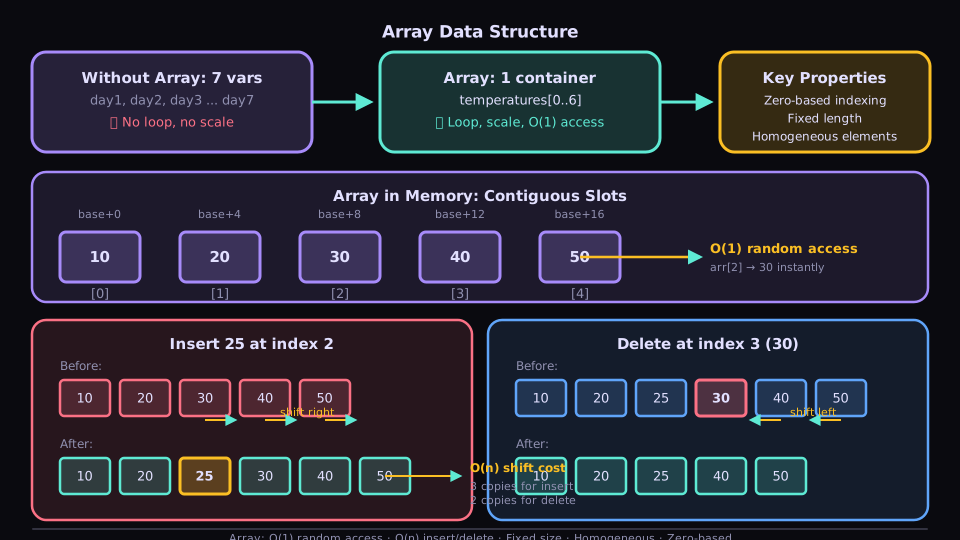
For example, imagine a stack of plates: you can only add or remove from the top (Last-In-First-Out). A queue is like a line at a store: you join at the back and leave from the front (First-In-First-Out). A list is like a row of lockers: you can access any locker directly by its number, but adding or removing in the middle might require shifting everything.
The key is that the rules are the structure — they define the data structure itself. The same underlying memory (like an array or linked nodes) can implement different rules, but the rules determine the performance trade-offs (e.g., fast access vs. fast insertion).
Worked example
Building a Stack: A Step-by-Step Walkthrough
Let's build a stack from scratch using a real-world scenario. Imagine you're processing a pile of forms — each new form goes on top, and you always take the top form first. This is exactly how a stack works (Last-In, First-Out).
Given: We have an empty stack and three items to process: Form A, Form B, Form C.
Steps:
1. Push Form A → Stack:
2. Push Form B → Stack:
3. Push Form C → Stack:
4. Pop → Remove C, return C. Stack:
5. Peek → Look at top without removing: returns B. Stack unchanged:
6. Pop → Remove B, return B. Stack:
7. Pop → Remove A, return A. Stack:
1. Push Form A → Stack:
[A] (top is A)2. Push Form B → Stack:
[A, B] (top is B)3. Push Form C → Stack:
[A, B, C] (top is C)4. Pop → Remove C, return C. Stack:
[A, B] (top is B)5. Peek → Look at top without removing: returns B. Stack unchanged:
[A, B]6. Pop → Remove B, return B. Stack:
[A] (top is A)7. Pop → Remove A, return A. Stack:
[] (empty)Result: The stack correctly returned items in reverse order of insertion: C, B, A. This is the defining behavior of a stack — the last item pushed is always the first popped.
Now, a common question: what happens if we try to pop from an empty stack? This is called an underflow error — the operation is invalid because there's nothing to remove. Real implementations handle this by checking if the stack is empty before popping.
Apply
Applying the Stack: Debugging a Nested Function Call
Let’s move from a stack of plates to a stack of function calls. When a program runs, it uses a call stack — a real-world data structure — to keep track of which function is running and where to return when it finishes.
Scenario: You write a small program that calculates the factorial of 3:
When
factorial(3) is called, the computer pushes a frame onto the call stack: {n: 3, return address: main}. Before it can return, it calls factorial(2), so it pushes another frame: {n: 2, return address: factorial(3)}. Then factorial(1) is called, pushing {n: 1, return address: factorial(2)}.Now
factorial(1) hits the base case and returns 1. The computer pops that frame off the stack. The top frame is now {n: 2}, which computes 2 * 1 = 2 and returns. Pop again. The top frame is {n: 3}, which computes 3 * 2 = 6 and returns. Finally, print receives 6.Your turn: Imagine a function
a() calls b(), which calls c(), and c() calls d(). If d() raises an error, the stack trace shows the sequence of calls from a to d. Why does the trace show a → b → c → d in that order? Because the stack pushes each call in order, and when the error occurs, the stack is unwound from top (most recent) to bottom (oldest). The trace is literally a snapshot of the call stack at the moment of the error.This is not just theory — every time you see a stack trace in your browser's developer console or in a Python traceback, you are seeing a data structure in action. The stack model explains both the order of execution and the debugging output you rely on.
FAQ
What is a data structure?
A data structure is a way to organize and store data so it can be used efficiently. Think of it as a container with specific rules for how data is added, removed, and accessed.
When should I use a stack?
Use a stack when you need Last-In-First-Out (LIFO) behavior, such as undo operations in text editors, parsing expressions, or tracking function calls in recursion.
What are common pitfalls with stacks?
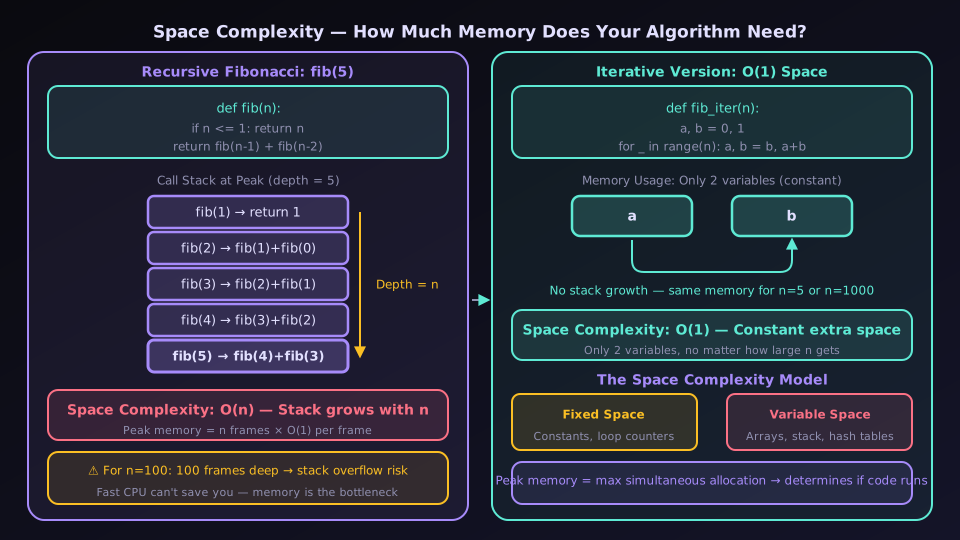
Common pitfalls include stack overflow (exceeding memory limits) and underflow (trying to pop from an empty stack). Always check if the stack is empty before popping.
What is the time complexity of stack operations?
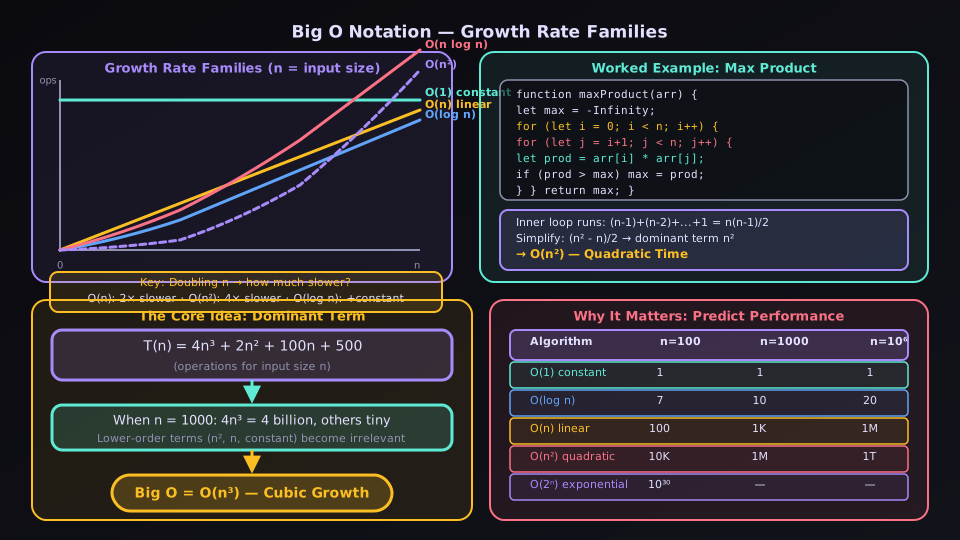
Push and pop operations on a stack are O(1) (constant time) when implemented with an array or linked list, assuming no resizing overhead.
How does a stack help debug nested function calls?
Each function call is pushed onto the call stack. When a function returns, it is popped. This lets you trace the order of calls and identify where errors occur.